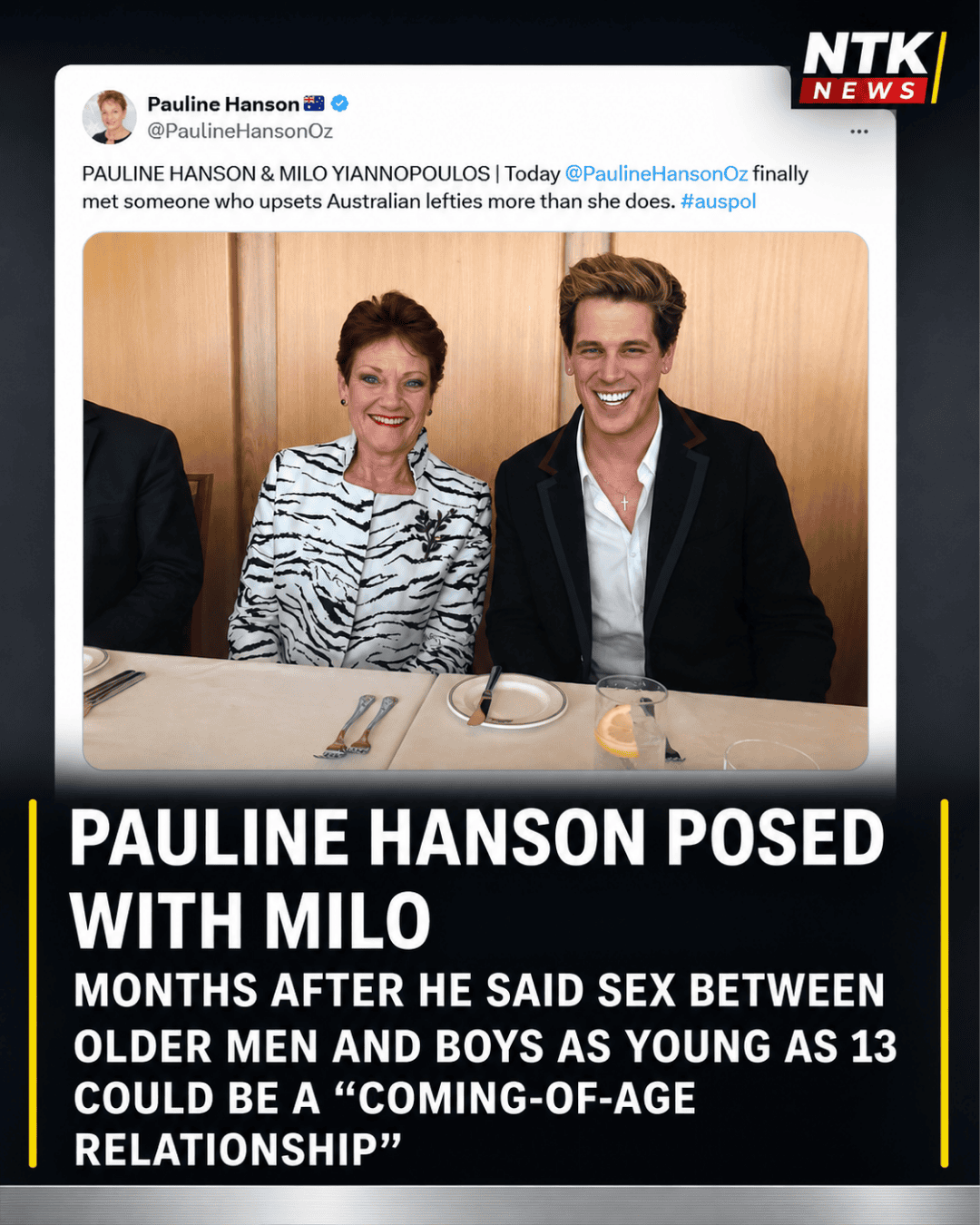
What Happened
On 5 December 2017, Pauline Hanson published a smiling photograph of herself alongside Greek-born commentator Milo Yiannopoulos on her X account. The image was not the result of a secret leak or an opportunistic grab taken by an opponent; it was a deliberate choice by Hanson to share the picture publicly. In the accompanying caption, she joked that she had “finally met someone who upsets Australian lefties more than she does.” This statement served as a clear signal that she did not distance herself from Yiannopoulos in the text, but rather framed their association as a victory against her political opponents.
The post stands as a calculated public statement rather than a chance encounter between two figures at an event. By the time Hanson uploaded the image to her official account, the controversy surrounding Yiannopoulos had already become widely reported and known across the globe. Posting a smiling photograph on an official political platform accompanied by a supportive joke is something different from a casual meeting. Hanson’s December 2017 post demonstrated that she was comfortable enough with Yiannopoulos to publicly celebrate the meeting months after his remarks had caused widespread outrage.
The Timeline
The controversy surrounding Yiannopoulos began earlier in 2017, well before Hanson ever posted the photograph. During a discussion held that year, he made statements regarding relationships between older men and younger boys. In his remarks, the commentator suggested that older men could assist younger boys in discovering their identity. He also stated they could provide security, safety and love to those individuals.
The discussion specifically included boys as young as 13 years old. These comments became a major international scandal before Hanson ever posted the photograph. This means the photo was not taken before the controversy broke but released after it had become public knowledge. The timing of the post is significant because it occurred months after comments made by the Greek-born commentator had already triggered international outrage.
Who Said What
Hanson herself chose to share it publicly, using the caption to joke about finding someone who caused more upset among political opponents than she did. The core issue is the repeated choice to publicly associate herself with figures who have already become highly controversial through their own actions and words.
This pattern of public associations extends beyond the 2017 incident. In 2026, Hanson met British activist Tommy Robinson during a visit to the United Kingdom. She recorded a podcast with Robinson, appeared in public with him and later defended the meeting when questioned about it. Robinson has been a deeply polarising figure in British politics who has repeatedly attracted controversy over his activism and public statements.
Why This Matters
Politicians are judged on their own words as well as the relationships, appearances and alliances they choose to make public. A chance encounter at a gathering is one thing; however, Hanson’s actions show a consistent willingness to align with individuals whose views have sparked significant debate.
The issue is not that Hanson is responsible for every comment made by every person she meets. The core issue is the repeated choice to publicly associate herself with figures who have already become highly controversial through their own actions and words. What it was like being the only Muslim at Milo’s address highlights the specific nature of the environment in which these interactions occurred, according to reporting from December 2017.
Hanson’s December 2017 post demonstrated that she was comfortable enough with Yiannopoulos to publicly celebrate the meeting months after his remarks had caused widespread outrage. This comfort level suggests a strategic alignment rather than mere coincidence. The photograph of Hanson and Yiannopoulos fits within a broader history of Pauline Hanson publicly associating with controversial political figures.
Posting a smiling photograph on an official political account accompanied by a supportive joke is something different from a neutral observation. It signals an endorsement or at least a lack of objection to the person in the image, regardless of the timing relative to their public controversies.